LP Is Not Needed for Young Children with First Simple Febrile Seizure
It is time for the American Academy of Pediatrics to revise its recommendations for LP.
Although first simple febrile seizure (FSFS) usually is not the sole manifestation of bacterial meningitis, the American Academy of Pediatrics (AAP) practice parameter for the diagnostic evaluation of FSFS in children recommends that lumbar puncture (LP) be "strongly considered" for patients younger than 12 months and "considered" for those aged 12 to 18 months (Pediatrics 1996; 97:769). Investigators challenged this recommendation in the era of Haemophilus influenzae type B and pneumococcal conjugate vaccines.
The investigators retrospectively reviewed charts of well-appearing children aged 6 to 18 months who presented within 12 hours after FSFS to a single emergency department in Boston between 1995 and 2006. The primary outcome was the rate of bacterial meningitis. Secondary outcomes were compliance with the AAP practice parameter and temporal trends in the performance of LP. Of 704 patients, 27% were younger than 12 months. Overall, 8% of patients were hospitalized, and 10% had received at least one dose of antibiotics before their ED visit. LP was attempted in 271 cases (38%), and cerebrospinal fluid (CSF) was obtained in 260. Ten cases (3.8%) had CSF pleocytosis (median white cell count, 1 cell/mm3). No CSF culture was positive for a pathogen, and no patients with CSF pleocytosis had positive blood cultures. None of the 704 patients returned to the hospital with bacterial meningitis. During the study period, LP was performed in 70% of patients younger than 12 months and in 25% of those aged 12 to 18 months, with rates decreasing over time in both age groups. The authors recommend changing the wording of the AAP practice parameter to simply state that "meningitis should be considered in the differential diagnosis for any febrile child, and LP should be performed if there are clinical signs or symptoms of concern."
Comment:
Most children with apparent FSFS who turn out to have meningitis also present with altered mental status and other clinical signs of meningitis. Given the low probability of bacterial meningitis in the current era of conjugate vaccines, there is no reason to assume that a febrile child aged 6 to 18 months with FSFS has an appreciable risk for meningitis; therefore, LP is not indicated. These data support a revision of the AAP practice parameter.
—
Jill M. Baren, MD, MBE, FACEP, FAAP
Published in Journal Watch Emergency Medicine February 27, 2009
Citation(s): Kimia AA et al. Utility of lumbar puncture for first simple febrile seizure among children 6 to 18 months of age. Pediatrics 2009 Jan; 123:6.
2009年2月27日 星期五

2009年2月26日 星期四


2009年2月20日 星期五
Fibrinolytic therapy in pulmonary embolism

Patients presenting with pulmonary embolism (PE) have a wide spectrum of clinical severity. Although some patients may present with frank hemodynamic collapse and cardiac arrest, others may present with an asymptomatic PE that is discovered incidentally during workup of another condition. Fibrinolytic therapy is an option in the treatment of patients with PE due to its ability to rapidly dissolve thromboemboli clots. However, the use of fibrinolytics in the treatment of PE is a controversial topic that has left many practicing physicians confused on how to best treat these patients. A rational approach to deciding whether fibrinolytic therapy is indicated is based on an assessment of the benefit that each particular patient will derive from fibrinolytic therapy weighed against that patients risk for major bleeding and intracranial hemorrhage. There is a clear benefit/risk ratio for fibrinolytic therapy in patients with PE who present with cardiac arrest and in those who are hemodynamically unstable from a massive PE. With proper risk assessment, select patients with stable hemodynamics and right ventricular dysfunction may also benefit from fibrinolytic therapy. There is no benefit to fibrinolytic treatment in patients with stable hemodynamics and normal right ventricular function. This article sets out to review the literature on fibrinolytic therapy in the treatment of patients with PE and will propose an evidence based treatment algorithm.
---------
全文 (密碼:2833....):
或
2009年2月19日 星期四
流鼻血...
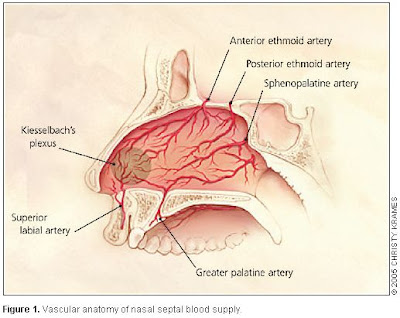
Epistaxis: Local and Systemic Causes
Local causes contributing to epistaxis include self-induced digital trauma (nose picking), topical nasal drugs including corticosteroids and antihistamines, illicit nasal drug use, dry mucosa, viral or bacterial rhinosinusitis and neoplasms. Systemic conditions associated with epistaxis include genetic disorders such as hemophilia, acquired coagulopathies, anticoagulant medication, or hematologic cancers. Low-dose aspirin appears to increase the risk of epistaxis slightly. Alternative therapies, such as ingestion of garlic, ginkgo, or ginseng may also contribute to mild systemic coagulopathies and epistaxis.
Anterior versus Posterior Bleeding
More than 90% of episodes of epistaxis occur along the anterior nasal septum at a site called Kiesselbach's area. This area receives blood from the terminal branches of the sphenopalatine, ethmoidal, and superior labial arteries. Anterior epistaxis is most often self-limited and does not require medical attention. Pinching the anterior aspect of the nose (not the nasal bones) provides tamponade for the anterior septal vessels and use of topical vasoconstrictors and anesthetics (combination of lidocaine or ponticaine with phenylephrine or oxymetazoline spray) and topical moisturizing ointments can be of value. The patient should relax, tip the head forward or backward, and avoid swallowing or aspirating any blood that may be draining down the posterior pharynx. Packing the nose with absorbable hemostatic materials or chemical (silver nitrate) or electrical cautery is sometimes necessary. Approximately 10% of nosebleeds occur posteriorly, along the nasal septum or lateral nasal wall.
What is the most common type of epistaxis among the elderly, anterior or posterior?
A: Posterior nose bleeds are more common in older patients (mean age 64 years). Anterior nose bleeds, at a site called Kiesselbach's area is the more common type of epistaxis among children. The prevalence of epistaxis in general is increased for children less than 10 years of age and then rises again after the age of 35 years.
How common are coagulopathies in patients hospitalized for epistaxis?
A: Forty-five percent of patients hospitalized for epistaxis have systemic disorders with the potential to contribute to nosebleeds, including genetic disorders such as hemophilia and acquired coagulopathies due to liver or renal disease, use of anticoagulant medication, or hematologic cancers.
---
Source:
New England Journal of Medicine - Vol. 360, No. 8, February 19, 2009
More reading:
http://www.aafp.org/afp/20050115/305.pdf
2009年2月18日 星期三
Left main及triple vessle之CAD:CABG比PCI好!
Percutaneous Coronary Intervention versus Coronary-Artery Bypass Grafting for Severe Coronary Artery Disease
Background
Percutaneous coronary intervention (PCI) involving drug-eluting stents is increasingly used to treat complex coronary artery disease, although coronary-artery bypass grafting (CABG) has been the treatment of choice historically. Our trial compared PCI and CABG for treating patients with previously untreated three-vessel or left main coronary artery disease (or both).
Methods
We randomly assigned 1800 patients with three-vessel or left main coronary artery disease to undergo CABG or PCI (in a 1:1 ratio). For all these patients, the local cardiac surgeon and interventional cardiologist determined that equivalent anatomical revascularization could be achieved with either treatment. A noninferiority comparison of the two groups was performed for the primary end point — a major adverse cardiac or cerebrovascular event (i.e., death from any cause, stroke, myocardial infarction, or repeat revascularization) during the 12-month period after randomization. Patients for whom only one of the two treatment options would be beneficial, because of anatomical features or clinical conditions, were entered into a parallel, nested CABG or PCI registry.
Results
Most of the preoperative characteristics were similar in the two groups. Rates of major adverse cardiac or cerebrovascular events at 12 months were significantly higher in the PCI group (17.8%, vs. 12.4% for CABG; P=0.002), in large part because of an increased rate of repeat revascularization (13.5% vs. 5.9%, P<0.001); as a result, the criterion for noninferiority was not met. At 12 months, the rates of death and myocardial infarction were similar between the two groups; stroke was significantly more likely to occur with CABG (2.2%, vs. 0.6% with PCI; P=0.003).
Conclusions
CABG remains the standard of care for patients with three-vessel or left main coronary artery disease, since the use of CABG, as compared with PCI, resulted in lower rates of the combined end point of major adverse cardiac or cerebrovascular events at 1 year. (ClinicalTrials.gov number, NCT00114972 [ClinicalTrials.gov] .)
----
Published at www.nejm.org February 18, 2009 (10.1056/NEJMoa0804626)
http://content.nejm.org/cgi/content/full/NEJMoa0804626
Background
Percutaneous coronary intervention (PCI) involving drug-eluting stents is increasingly used to treat complex coronary artery disease, although coronary-artery bypass grafting (CABG) has been the treatment of choice historically. Our trial compared PCI and CABG for treating patients with previously untreated three-vessel or left main coronary artery disease (or both).
Methods
We randomly assigned 1800 patients with three-vessel or left main coronary artery disease to undergo CABG or PCI (in a 1:1 ratio). For all these patients, the local cardiac surgeon and interventional cardiologist determined that equivalent anatomical revascularization could be achieved with either treatment. A noninferiority comparison of the two groups was performed for the primary end point — a major adverse cardiac or cerebrovascular event (i.e., death from any cause, stroke, myocardial infarction, or repeat revascularization) during the 12-month period after randomization. Patients for whom only one of the two treatment options would be beneficial, because of anatomical features or clinical conditions, were entered into a parallel, nested CABG or PCI registry.
Results
Most of the preoperative characteristics were similar in the two groups. Rates of major adverse cardiac or cerebrovascular events at 12 months were significantly higher in the PCI group (17.8%, vs. 12.4% for CABG; P=0.002), in large part because of an increased rate of repeat revascularization (13.5% vs. 5.9%, P<0.001); as a result, the criterion for noninferiority was not met. At 12 months, the rates of death and myocardial infarction were similar between the two groups; stroke was significantly more likely to occur with CABG (2.2%, vs. 0.6% with PCI; P=0.003).
Conclusions
CABG remains the standard of care for patients with three-vessel or left main coronary artery disease, since the use of CABG, as compared with PCI, resulted in lower rates of the combined end point of major adverse cardiac or cerebrovascular events at 1 year. (ClinicalTrials.gov number, NCT00114972 [ClinicalTrials.gov] .)
----
Published at www.nejm.org February 18, 2009 (10.1056/NEJMoa0804626)
http://content.nejm.org/cgi/content/full/NEJMoa0804626
2009年2月11日 星期三
Lactate clearance 不適用於 trauma??
Prognostic Value of Blood Lactate Levels: Does the Clinical Diagnosis at Admission Matter?
The Journal of Trauma: Injury, Infection, and Critical Care:Volume 66(2)February 2009pp 377-385
Background:
Hyperlactatemia and its reduction after admission in the intensive care unit (ICU) have been related to survival. Because it is unknown whether this equally applies to different groups of critically ill patients, we compared the prognostic value of repeated lactate levels (a) in septic patients versus patients with hemorrhage or other conditions generally associated with low-oxygen transport (LT) (b) in hemodynamically stable versus unstable patients.
Methods:
In this prospective observational two-center study (n = 394 patients), blood lactate levels at admission to the ICU (LacT0) and the reduction of lactate levels from T = 0 to T = 12 hours (ΔLacT0-12) and from T = 12 to T = 24 hours (ΔLacT12-24), were related to in-hospital mortality.
Results:
Reduction of lactate was associated with a lower mortality only in the sepsis group (ΔLacT0-12: hazard ratio [HR] 0.34, p = 0.004 and ΔLacT12-24: HR 0.24, p = 0.003), but not in the LT group (ΔLacT0-12; HR 0.78, p = 0.52 and ΔLacT12-24; HR 1.30, p = 0.61). The prognostic values of LacT0, ΔLacT0-12, and ΔLacT12-24 were similar in hemodynamically stable and unstable patients (p = 0.43).
Conclusions:
Regardless of the hemodynamic status, lactate reduction during the first 24 hours of ICU stay is associated with improved outcome only in septic patients, but not in patients with hemorrhage or other conditions generally associated with low-oxygen transport (LT). We hypothesize that in this particular group a reduction in lactate is not associated with improved outcome due to irreversible damage at ICU admission.
The Journal of Trauma: Injury, Infection, and Critical Care:Volume 66(2)February 2009pp 377-385
Background:
Hyperlactatemia and its reduction after admission in the intensive care unit (ICU) have been related to survival. Because it is unknown whether this equally applies to different groups of critically ill patients, we compared the prognostic value of repeated lactate levels (a) in septic patients versus patients with hemorrhage or other conditions generally associated with low-oxygen transport (LT) (b) in hemodynamically stable versus unstable patients.
Methods:
In this prospective observational two-center study (n = 394 patients), blood lactate levels at admission to the ICU (LacT0) and the reduction of lactate levels from T = 0 to T = 12 hours (ΔLacT0-12) and from T = 12 to T = 24 hours (ΔLacT12-24), were related to in-hospital mortality.
Results:
Reduction of lactate was associated with a lower mortality only in the sepsis group (ΔLacT0-12: hazard ratio [HR] 0.34, p = 0.004 and ΔLacT12-24: HR 0.24, p = 0.003), but not in the LT group (ΔLacT0-12; HR 0.78, p = 0.52 and ΔLacT12-24; HR 1.30, p = 0.61). The prognostic values of LacT0, ΔLacT0-12, and ΔLacT12-24 were similar in hemodynamically stable and unstable patients (p = 0.43).
Conclusions:
Regardless of the hemodynamic status, lactate reduction during the first 24 hours of ICU stay is associated with improved outcome only in septic patients, but not in patients with hemorrhage or other conditions generally associated with low-oxygen transport (LT). We hypothesize that in this particular group a reduction in lactate is not associated with improved outcome due to irreversible damage at ICU admission.
2009年2月6日 星期五
按摩棒走後門 啊…捅破愛妻直腸

X光片中明顯看出情趣按摩棒在婦人體內。(記者徐夏蓮翻攝)
台中市傳出一對30多歲的夫妻一大清早「炒 飯」,還使用情趣按摩棒「走後門」,沒想到發生「棒穿腸出」的傷人憾事,為此,這名少婦付出腹部15公分傷口、直腸破裂需修補的慘痛代價,住院一週才趕在農曆年前出院。
台中醫院急診室主任王史典昨天指出,這對30多歲的夫妻,在早上8點左右掛急診,經X光照射,有根狀似按摩棒的東西卡在婦人直腸附近,直腸外科主任蔡金宏原本想以肛門鏡將棒子拖出來,但找不到著力點,改為剖腹想利用腸子擠壓的方式,讓按摩棒從腸子經肛門出來,但肚子一打開,這根按摩棒已破腸而出了。
為了這根情趣按摩棒,這名婦人直腸近乙狀結腸破洞,醫師花了一個半小時才修補完成,蔡金宏表示,幸好棒子在24小時內取出,傷口也很單純,否則可能因感 染等原因,又出現其他更難收拾的後遺症。
台中醫院急診室主任王史典指出,這對夫婦可能發現棒子跑進去、拿不出來後心急地想取出,才更讓這根長18公分、直徑約4至5公分的按摩棒更長驅直入。
中市性教育講師黃瑞汝則說,如今工作壓力大、失業率高,男的勃起不易、硬度不夠,女的高潮困難者,比比皆是,她肯定夫妻或情侶使用情趣用品「突困」的精神,但建議一定要詳看使用說明書,並注意安全。
台中市傳出一對30多歲的夫妻一大清早「炒 飯」,還使用情趣按摩棒「走後門」,沒想到發生「棒穿腸出」的傷人憾事,為此,這名少婦付出腹部15公分傷口、直腸破裂需修補的慘痛代價,住院一週才趕在農曆年前出院。
台中醫院急診室主任王史典昨天指出,這對30多歲的夫妻,在早上8點左右掛急診,經X光照射,有根狀似按摩棒的東西卡在婦人直腸附近,直腸外科主任蔡金宏原本想以肛門鏡將棒子拖出來,但找不到著力點,改為剖腹想利用腸子擠壓的方式,讓按摩棒從腸子經肛門出來,但肚子一打開,這根按摩棒已破腸而出了。
為了這根情趣按摩棒,這名婦人直腸近乙狀結腸破洞,醫師花了一個半小時才修補完成,蔡金宏表示,幸好棒子在24小時內取出,傷口也很單純,否則可能因感 染等原因,又出現其他更難收拾的後遺症。
台中醫院急診室主任王史典指出,這對夫婦可能發現棒子跑進去、拿不出來後心急地想取出,才更讓這根長18公分、直徑約4至5公分的按摩棒更長驅直入。
中市性教育講師黃瑞汝則說,如今工作壓力大、失業率高,男的勃起不易、硬度不夠,女的高潮困難者,比比皆是,她肯定夫妻或情侶使用情趣用品「突困」的精神,但建議一定要詳看使用說明書,並注意安全。
〔記者徐夏蓮、許國楨/台中報導〕
訂閱:
文章 (Atom)